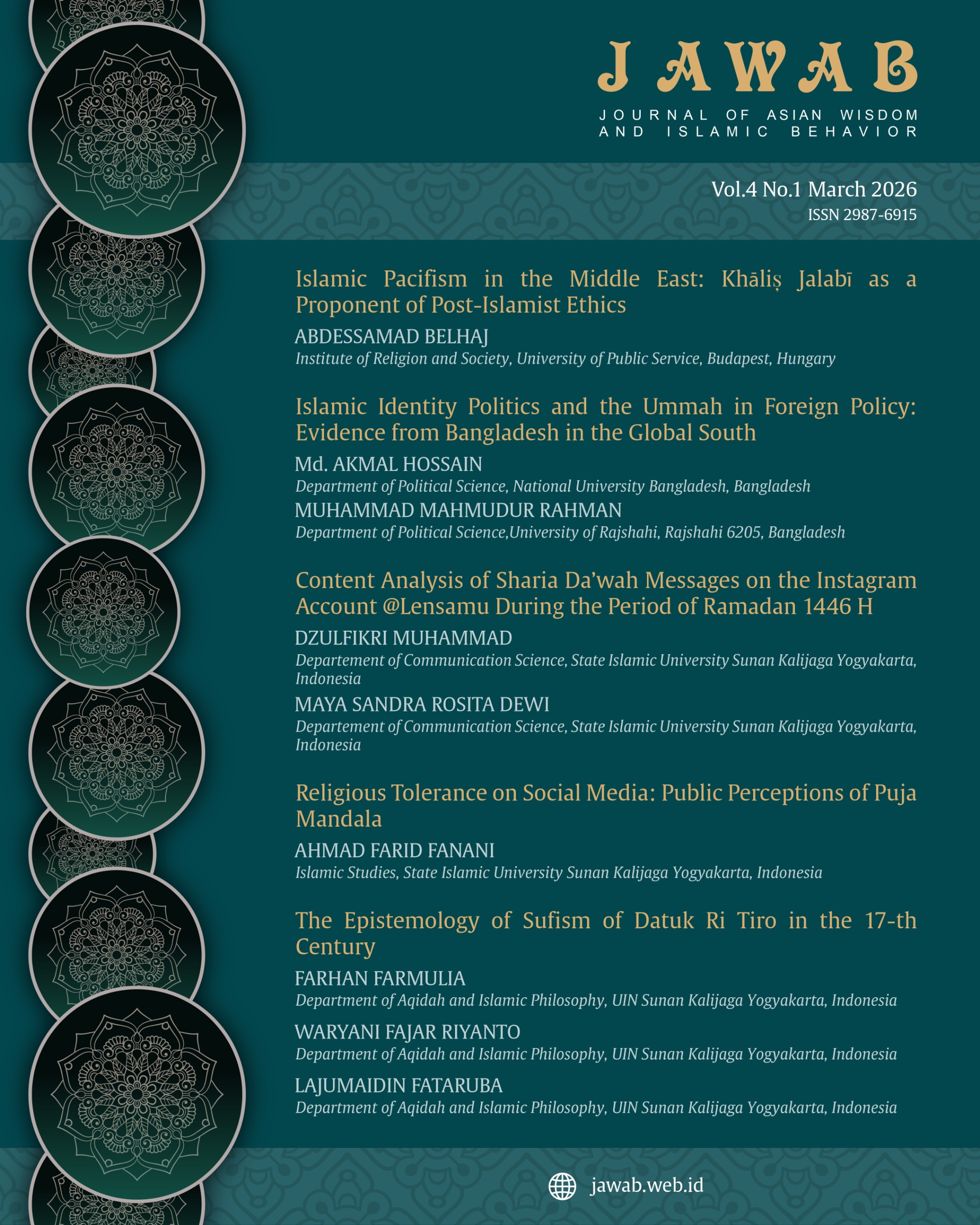
Islamic Identity Politics and the Ummah in Foreign Policy: Evidence from Bangladesh in the Global South
DOI:
https://doi.org/10.59371/jawab.v4i1.114Keywords:
Bangladesh, foreign policy, Religion, Islam, Identity politics, Global southAbstract
This article examines how Islam, as one of the central components of Bangladesh's national identity, influences its foreign policy. Based on secondary sources and employing an identity politics framework grounded in the concept of the ummah, this paper argues that Bangladesh’s external relations are influenced not only by material interests and geopolitical considerations but also by religious values and political uses of Islamic identity. Through historical analysis and case studies, including relations with Muslim-majority states such as India and Pakistan, as well as the Israel–Palestine conflict, the study demonstrates how religious affinity, the roles of political parties in government and opposition, and economic interdependence interact to shape foreign relations. The findings demonstrate that religious identity serves as both a normative guide and a political resource, with its impact mediated by the ruling party's ideology and strategic interests. The contribution of this article is to broaden the debates on the role of religion in the foreign policy-making process in third-world nations, particularly in Muslim-majority countries.
Downloads
Published
Issue
Section
Citation Check
License
Copyright (c) 2026 Md. Akmal Hossain, Muhammad Mahmudur Rahman

This work is licensed under a Creative Commons Attribution-ShareAlike 4.0 International License.