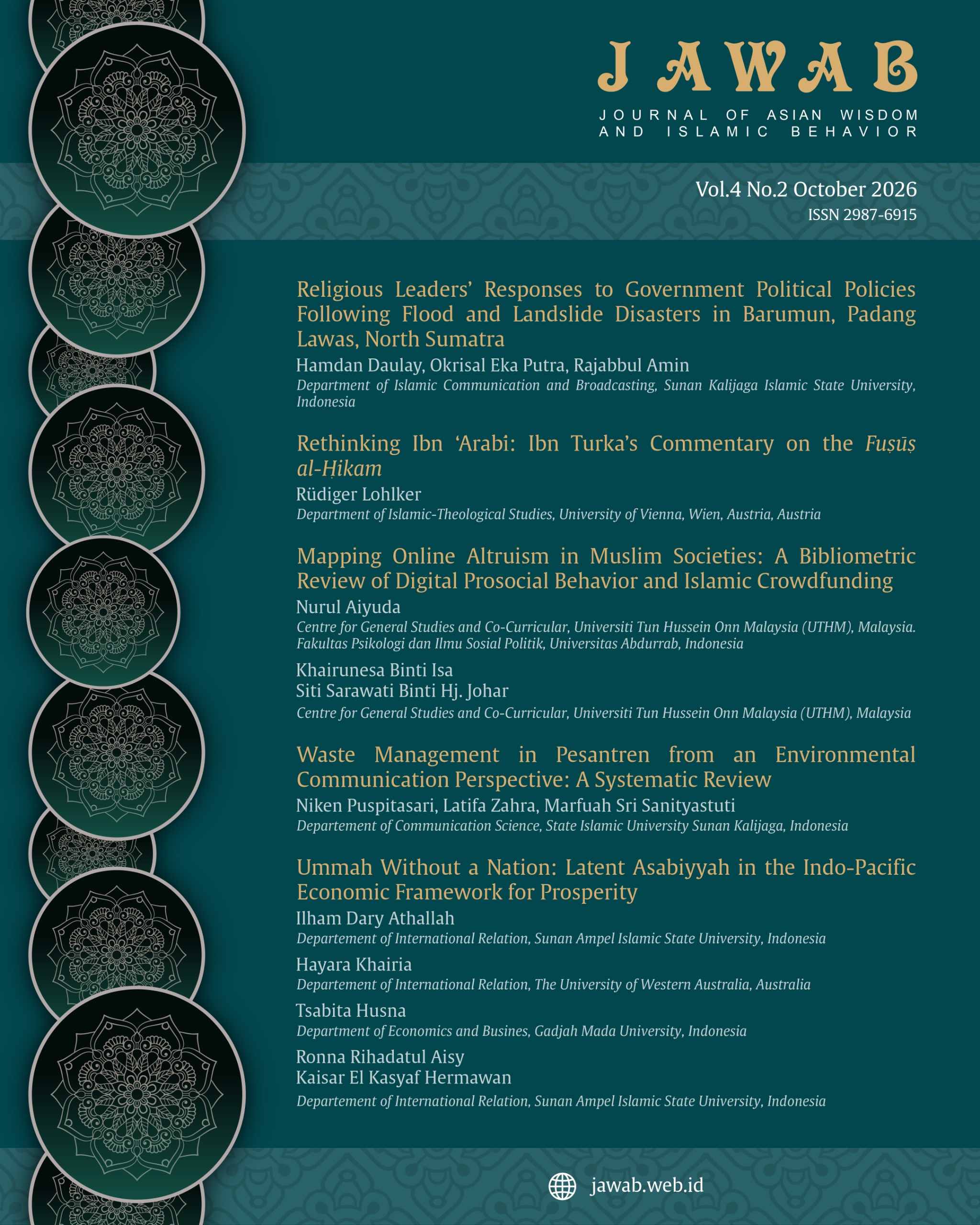
Mapping Online Altruism in Muslim Societies: A Bibliometric Review of Digital Prosocial Behavior and Islamic Crowdfunding
DOI:
https://doi.org/10.59371/jawab.v4i2.131Keywords:
Online Altruism, Islamic Crowdfunding, Waqf, Muslim Countries, Bibliometric AnalysisAbstract
Digital platforms have transformed altruistic and prosocial behavior, particularly in Muslim societies where charitable practices are shaped by religious and institutional norms. Yet the thematic structure and geographical distribution of research on online altruism remain unclear. This study examines how research on online altruism in Muslim societies has developed in terms of publication trends, thematic focus, and geographical distribution. Using a PRISMA-guided bibliometric review, the study analyzes Scopus-indexed articles published between 2020 and 2025, focusing on Muslim-majority and Muslim-context countries, particularly Indonesia and Malaysia, with emphasis on Islamic crowdfunding and digital prosocial activities. An initial search identified 285 records, screened according to publication year, subject area, document type, thematic relevance, and geographical context. This process yielded 35 crowdfunding-related articles, from which 19 studies focusing on Muslim-majority or Muslim-context countries were selected for analysis. Findings indicate that research on online altruism in Muslim societies has grown steadily since 2021 and is concentrated in Southeast Asia. Studies predominantly examine Islamic crowdfunding and digital waqf, highlighting trust, religiosity, Sharia compliance, and institutional governance as drivers of digital prosocial participation. The review identifies research gaps and calls for broader geographical coverage and diverse methodological approaches.
References
Abdullah, R., Ismail, S., & Thaker, H. M. T. (2021). Behavioral intention toward Islamic crowdfunding: Evidence from Malaysia. Journal of Islamic Marketing, 12(6), 1069–1085. https://doi.org/10.1108/JIMA-01-2020-0021
Aknin, L. B., Dunn, E. W., Proulx, J., Lok, I., & Norton, M. I. (2019). Does spending money on others promote happiness? A registered replication report. Journal of Personality and Social Psychology, 117(2), 329–354. https://doi.org/10.1037/pspa0000141
Aknin, L. B., Whillans, A. V., Norton, M. I., & Dunn, E. W. (2022). Happiness and prosocial behavior: An evaluation of the evidence. World Happiness Report, 1–17.
Batson, C. D. (2011). Altruism in humans. Oxford University Press.
Bekkers, R., & Wiepking, P. (2011). A literature review of empirical studies of philanthropy: Eight mechanisms that drive charitable giving. Nonprofit and Voluntary Sector Quarterly, 40(5), 924–973. https://doi.org/10.1177/0899764010380927
Belleflamme, P., Lambert, T., & Schwienbacher, A. (2014). Crowdfunding: Tapping the right crowd. Journal of Business Venturing, 29(5), 585–609. https://doi.org/10.1016/j.jbusvent.2013.07.003
Bénabou, R., & Tirole, J. (2006). Incentives and prosocial behavior. American Economic Review, 96(5), 1652–1678. https://doi.org/10.1257/aer.96.5.1652
Donthu, N., Kumar, S., Mukherjee, D., Pandey, N., & Lim, W. M. (2021). How to conduct a bibliometric analysis: An overview and guidelines. Journal of Business Research, 133, 285–296. https://doi.org/10.1016/j.jbusres.2021.04.070
Erreygers, S., Vandebosch, H., Vranjes, I., Baillien, E., & De Witte, H. (2018). Development of a measure of adolescents’ online prosocial behavior. Journal of Adolescence, 64, 54–65. https://doi.org/10.1016/j.adolescence.2018.01.008
Erreygers, S., Pabian, S., & Vandebosch, H. (2022). Online prosocial behavior: A review of the literature. Current Opinion in Psychology, 45, 101303. https://doi.org/10.1016/j.copsyc.2022.101303
Hassan, R., Abdullah, A., & Ahmad, A. U. F. (2021). Digital waqf management and crowdfunding innovation in Muslim countries. Journal of Islamic Accounting and Business Research, 12(4), 657–673. https://doi.org/10.1108/JIABR-08-2020-0241
Hasan, Z., & Siraj, S. A. (2022). Crowdfunding waqf for social welfare: Evidence from Southeast Asia. International Journal of Ethics and Systems, 38(3), 418–435. https://doi.org/10.1108/IJOES-10-2021-0187
Iqbal, Z., & Mirakhor, A. (2011). An introduction to Islamic finance: Theory and practice. Wiley.
Ishak, M. S. I., Aderemi, A. M. R., Mohammad Nasir, N. S., & Hassan, R. (2023). Factors influencing intention to participate in Islamic crowdfunding: A conceptual framework. Journal of Islamic Accounting and Business Research, 14(2), 321–340.
Kahf, M. (2015). Waqf: A quick overview. Islamic Research and Training Institute (IRTI), Islamic Development Bank.
Khan, T., Hassan, M. K., & Paltrinieri, A. (2020). Islamic finance and banking: Theory, practice and challenges. International Journal of Finance & Economics, 25(4), 451–469. https://doi.org/10.1002/ijfe.1754
Khoirunnisa, T. A. (2023). Determinants of donation intention in Islamic crowdfunding platforms: Evidence from Indonesia. Journal of Islamic Marketing.
Mohd Kassim, S. F., Md Zain, S. N., Zainon, S., & Hashim, H. A. (2022). Waqf-based crowdfunding and social sustainability. Sustainability, 14(18), 11234. https://doi.org/10.3390/su141811234
Mohsin, M. I. A., Hussain, S., & Aisha, A. (2020). Financing through Islamic crowdfunding: A qualitative study. Journal of Islamic Accounting and Business Research, 11(3), 547–564. https://doi.org/10.1108/JIABR-02-2017-0022
Mollick, E. (2014). The dynamics of crowdfunding: An exploratory study. Journal of Business Venturing, 29(1), 1–16. https://doi.org/10.1016/j.jbusvent.2013.06.005
Norenzayan, A., Shariff, A. F., Willard, A. K., Slingerland, E., McNamara, R. A., & Henrich, J. (2016). The cultural evolution of prosocial religions. Behavioral and Brain Sciences, 39, e1. https://doi.org/10.1017/S0140525X14001356
Rahman, A. A., & Haneef, M. A. (2022). Islamic social finance and crowdfunding for sustainable development. Sustainability, 14(9), 5142. https://doi.org/10.3390/su14095142
Thaker, H. M. T., & Thaker, M. A. B. M. T. (2022). Islamic crowdfunding: A systematic literature review and future research agenda. Journal of Islamic Marketing, 13(2), 428–458. https://doi.org/10.1108/JIMA-09-2020-0279
Thaker, H. M. T., Thaker, M. A. B. M. T., & Pitchay, A. A. (2021). Modeling charitable crowdfunding intention: Evidence from a Muslim society. Journal of Islamic Marketing, 12(6), 1049–1069. https://doi.org/10.1108/JIMA-07-2019-0149
Ulum, K. M., Ariyanti, S., Witro, D., & Nasyiah, I. (2023). Digital waqf crowdfunding and donor participation. International Journal of Islamic and Middle Eastern Finance and Management.
Venkatesh, V., Morris, M. G., Davis, G. B., & Davis, F. D. (2003). User acceptance of information technology: Toward a unified view. MIS Quarterly, 27(3), 425–478. https://doi.org/10.2307/30036540
Wahyudi, H., Tubarad, C. P. T., Rodliyah, N., & Kusuma, D. H. (2024). Online altruism and donation behavior in Islamic crowdfunding platforms. Journal of Islamic Marketing.
Zainudin, R., Mahdzan, N. S., & Yet, C. H. (2020). Crowdfunding success in Muslim markets. Pacific-Basin Finance Journal, 62, 101349. https://doi.org/10.1016/j.pacfin.2020.101349
Zupic, I., & Čater, T. (2015). Bibliometric methods in management and organization. Organizational Research Methods, 18(3), 429–472. https://doi.org/10.1177/1094428114562629
Downloads
Published
Issue
Section
Citation Check
License
Copyright (c) 2026 Nurul Aiyuda, Khairunesa Binti Isa, Siti Sarawati Binti Hj. Johar

This work is licensed under a Creative Commons Attribution-ShareAlike 4.0 International License.