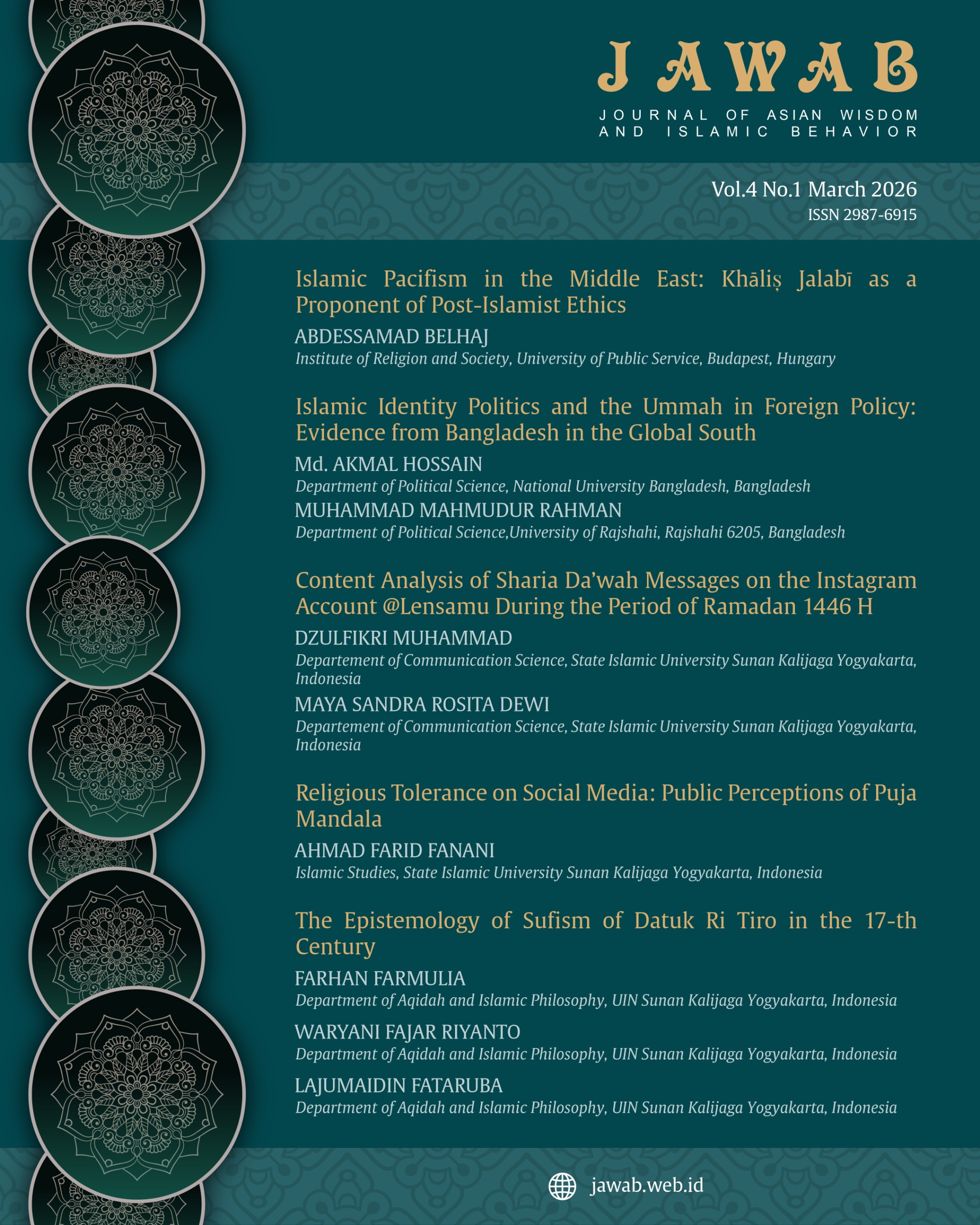
The Epistemology of Sufism of Datuk Ri Tiro in the 17th Century
DOI:
https://doi.org/10.59371/jawab.v4i1.133Keywords:
Epistemology, Sufism, Epistemology of Sufism, Datuk Ri TiroAbstract
This article examines the epistemology of Sufism (tasawuf) of Datuk ri Tiro, one of the key figures in the spread of Islam in Tiro, Bulukumba, and South Sulawesi in the 17th century. This study aims to understand how the structure of Sufi knowledge taught by Datuk ri Tiro was formed, validated, and practiced in the daily life of the Tiro community. This study employs a qualitative approach through library research by reviewing historical sources and academic works related to the Sufism of the Indonesian archipelago. The findings show that the epistemology of Sufism of Datuk ri Tiro is constructed through three main pillars: (1) the sources of Sufi knowledge rooted in the Minangkabau–Aceh tradition as well as Bugis–Makassar local wisdom; (2) methods of acquiring knowledge based on inner experience through dhikr, self-purification, and spiritual discipline; and (3) epistemic validity criteria grounded in purity of heart, continuity of dhikr, and the internalization of shari‘ah–tarekat–haqiqat–ma‘rifat. This study affirms that the epistemology of Datuk ri Tiro’s Sufism is not merely a historical legacy, but also a knowledge model relevant for strengthening spirituality and ethics in contemporary Muslim society.
Downloads
Published
Issue
Section
Citation Check
License
Copyright (c) 2026 Farhan Farmulia, Waryani Fajar Riyanto, Lajumaidin fataruba

This work is licensed under a Creative Commons Attribution-ShareAlike 4.0 International License.