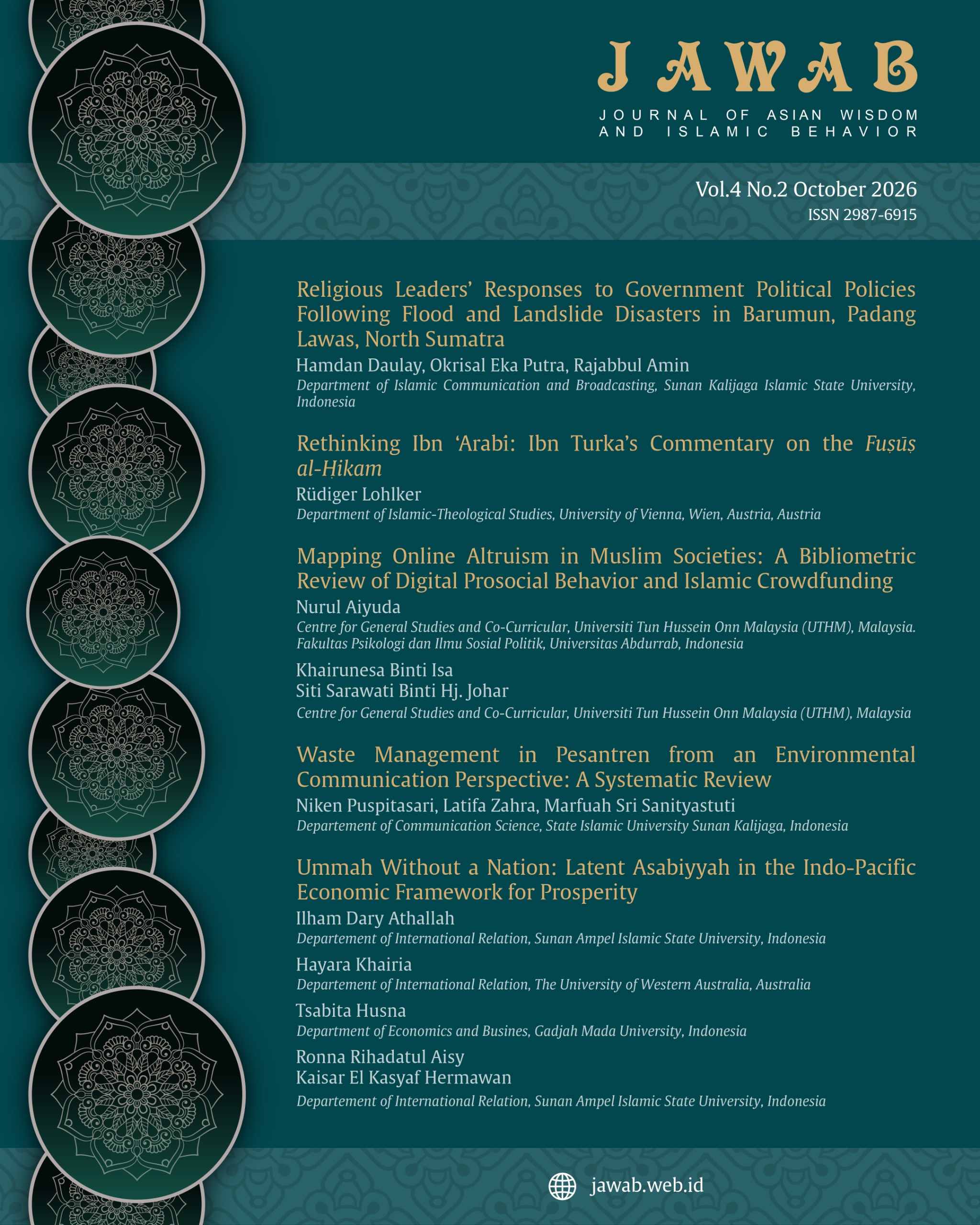
Rethinking Ibn ‘Arabi: Ibn Turka’s Commentary on the Fuṣūṣ al-Hikam
DOI:
https://doi.org/10.59371/jawab.v4i2.135Keywords:
Ibn Turka, Fuṣūṣ al-ḥikam, Ibn ʿArabī, Lettrism, Timurids, wahdat al-wujūdAbstract
Saʾīn al-Dīn Ibn Turka was a relatively lesser-known thinker of the post-Mongolian period who was active during Timurid rule in Iran. Despite his limited recognition, he was an influential intellectual of his time. This article examines his position within the field of Islamic knowledge in Timurid Iran, particularly his representation of a lettrist and occult approach. His thought reflects an early modern Islamic perspective that employs mathematical conceptions of reality, marking a distinctive development in Islamic intellectual history. The article situates Ibn Turka within the intellectual field of wahdat al-wujūd (Oneness of Being), particularly the commentary tradition on Ibn ʿArabī’s Fuṣūṣ al-Ḥikam. Since Ibn Turka’s commentary has received limited scholarly attention, this study provides an in-depth examination of the work and addresses a significant gap in wahdat al-wujūd studies. It also emphasizes the importance of examining the tradition’s later developments rather than focusing primarily on Ibn ʿArabī as its founder. Using Pierre Bourdieu’s field theory, the article conceptualizes wahdat al-wujūd as a dynamic field characterized by multiple intellectual contestations. This approach moves beyond genealogical studies and enables broader dialogue between Islamic intellectual traditions and other fields of knowledge.
Downloads
Published
Issue
Section
Citation Check
License
Copyright (c) 2026 Rüdiger Lohlker

This work is licensed under a Creative Commons Attribution-ShareAlike 4.0 International License.