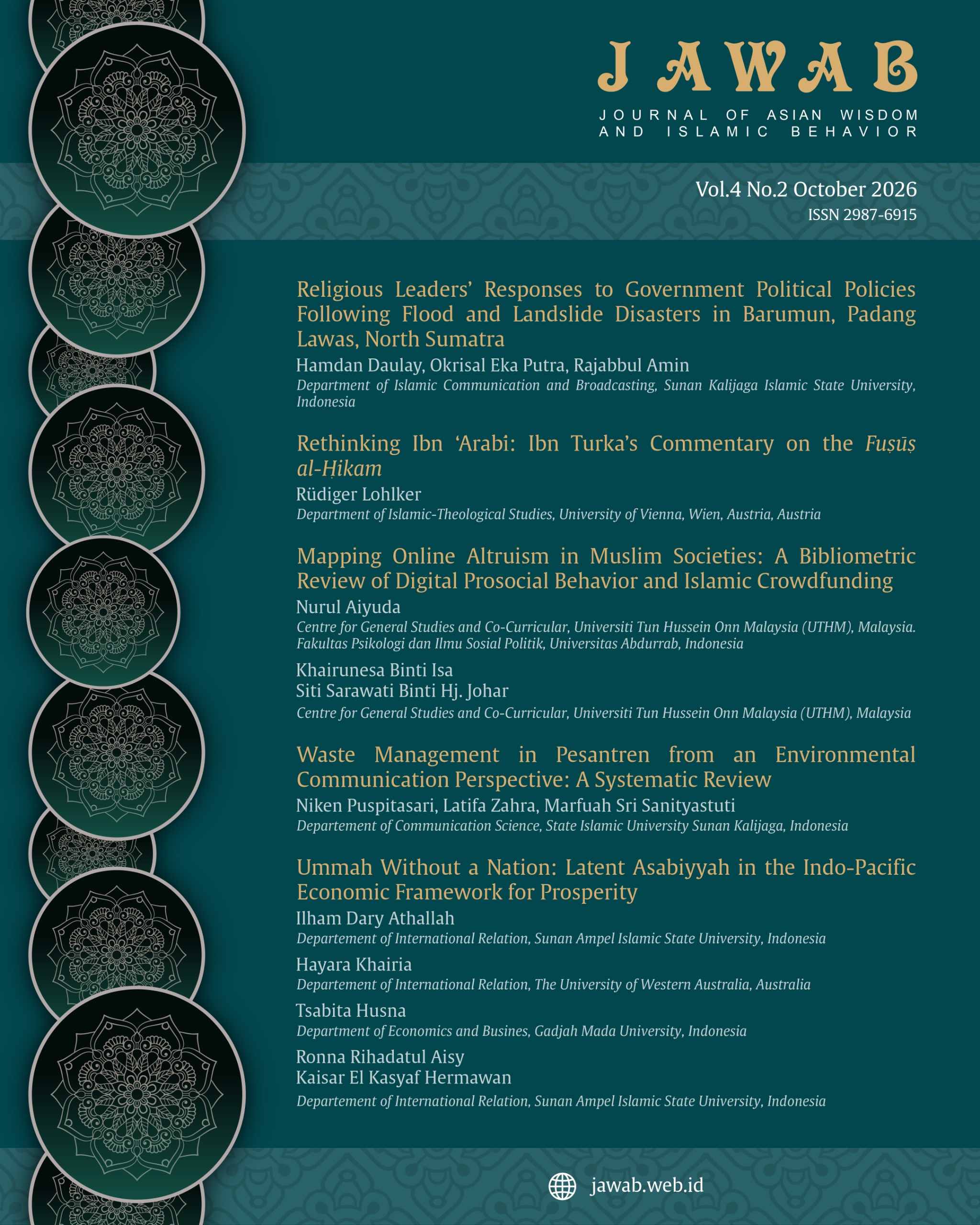
Ummah Without a Nation: Latent Asabiyyah in the Indo-Pacific Economic Framework for Prosperity
DOI:
https://doi.org/10.59371/jawab.v4i2.136Keywords:
Asabiyyah, Ummah, Indo-Pacific Economic Framework for Prosperity, Climate Club Diplomacy, Islamic International RelationsAbstract
Under this analytical approach, the Indo-Pacific Economic Framework for Prosperity places Muslim-majority Indonesia, Malaysia, and Brunei Darussalam inside a secular, investment-oriented clean-economy framework while all three also belong to the Organization of Islamic Cooperation. When sovereign states bargain through a non-Islamic climate club, this institutional overlap creates a problem for Islamic International Relations: whether the ummah functions as a politically consequential community. This article treats asabiyyah as the mechanism that could convert membership in the ummah into felt obligation and coordinated action. Using structured discourse analysis, policy-network mapping, and process tracing of public agreements, official statements, and implementation materials from 2022–2024, the study examines both activation and non-activation. The evidence shows no public Islamic caucus and almost no explicit ummah-based language. Coordination proceeds through technocratic vocabularies of mutual benefit, inclusivity, investment, and national transition needs. Asabiyyah is best understood here as a latent, conditional resource as opposed to an active coalition mechanism; when cooperation is organised through sovereign states, forum-specific secular codes, and heterogeneous domestic transition costs, the finding clarifies the ummah–nation relationship: transnational solidarity remains politically weak.
Downloads
Published
Issue
Section
Citation Check
License
Copyright (c) 2026 Ilham Dary, Hayara Khairia , Tsabita Husna, Ronna Rihadatul Aisy , KAISAR EL KASYAF HERMAWAN

This work is licensed under a Creative Commons Attribution-ShareAlike 4.0 International License.