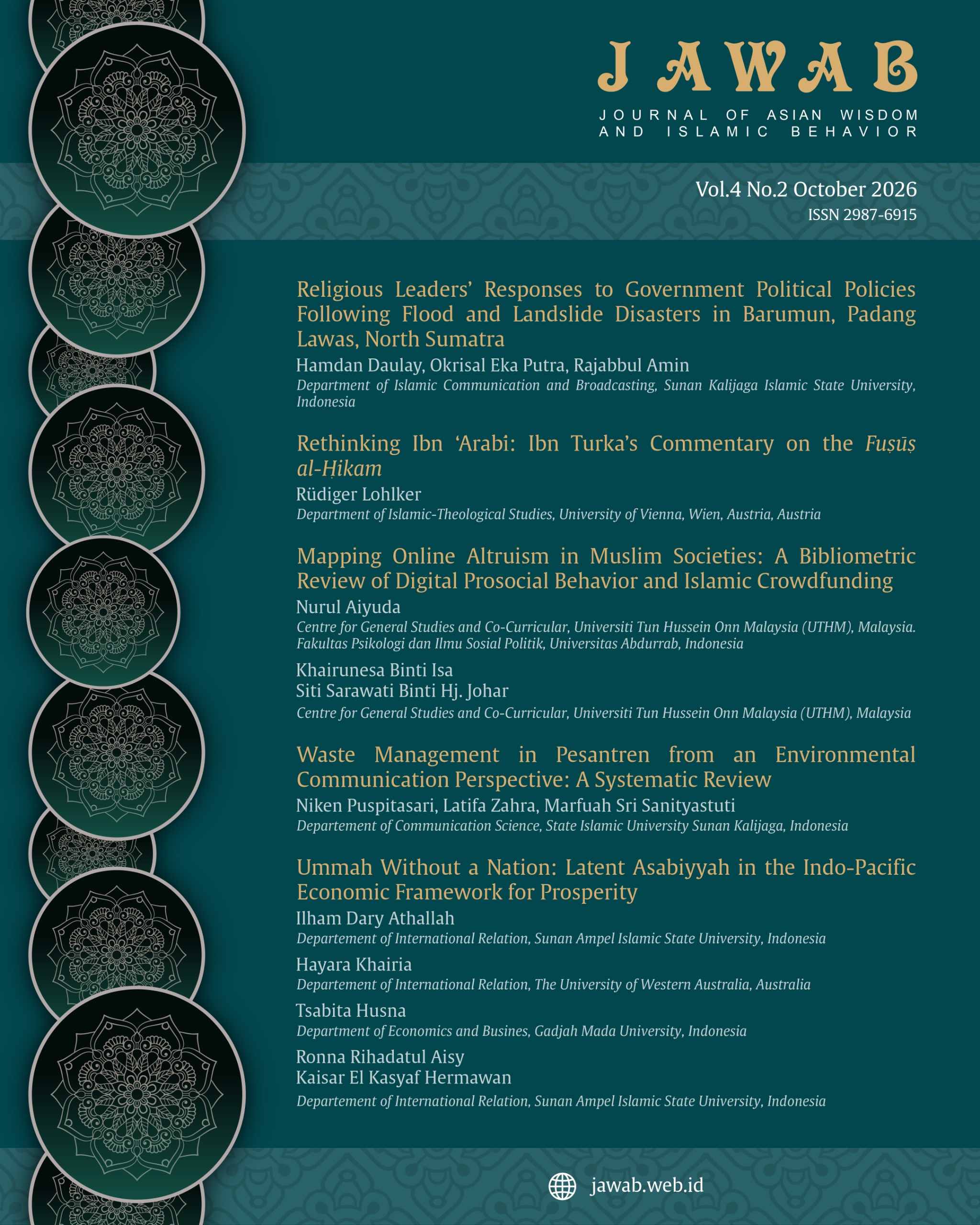
Religious Leaders’ Responses to Government Political Policies Following Flood and Landslide Disasters in Barumun, Padang Lawas, North Sumatra
DOI:
https://doi.org/10.59371/jawab.v4i2.138Keywords:
Religious Leaders, Political Policy, Disaster Recovery, Flood and Landslide Disasters, Environmental Conservation, Community ResilienceAbstract
Flood and landslide disasters in Barumun, Padang Lawas, North Sumatra, have caused significant social, economic, and environmental impacts. Beyond damaging infrastructure, agricultural land, and places of worship, these disasters have raised concerns regarding environmental degradation and the effectiveness of government recovery policies. In this context, religious leaders play an important role as moral authorities and community mediators in strengthening public resilience and responding to government initiatives. This study aims to examine the role of religious leaders in environmental conservation, their responses to environmental policies, and their perspectives on post-disaster recovery programs. Using a qualitative descriptive approach, data were collected through in-depth interviews, observation, and documentation involving twenty religious leaders, consisting of fifteen Muslim and five Christian leaders. The findings reveal that religious leaders contribute significantly to preventing environmental degradation by promoting religious values that encourage environmental stewardship. They also respond positively to government policies on forest conservation, illegal logging prevention, and reforestation. Furthermore, religious leaders strongly support post-disaster recovery programs, including the rehabilitation of places of worship, river restoration, economic recovery, and housing reconstruction. The study concludes that religious leaders are influential actors in promoting environmental awareness, supporting public policies, and strengthening community resilience in post-disaster settings.
Downloads
Published
Issue
Section
Citation Check
License
Copyright (c) 2026 Hamdan Daulay; Rajabbul Amin; Okrisal Eka Putra

This work is licensed under a Creative Commons Attribution-ShareAlike 4.0 International License.